
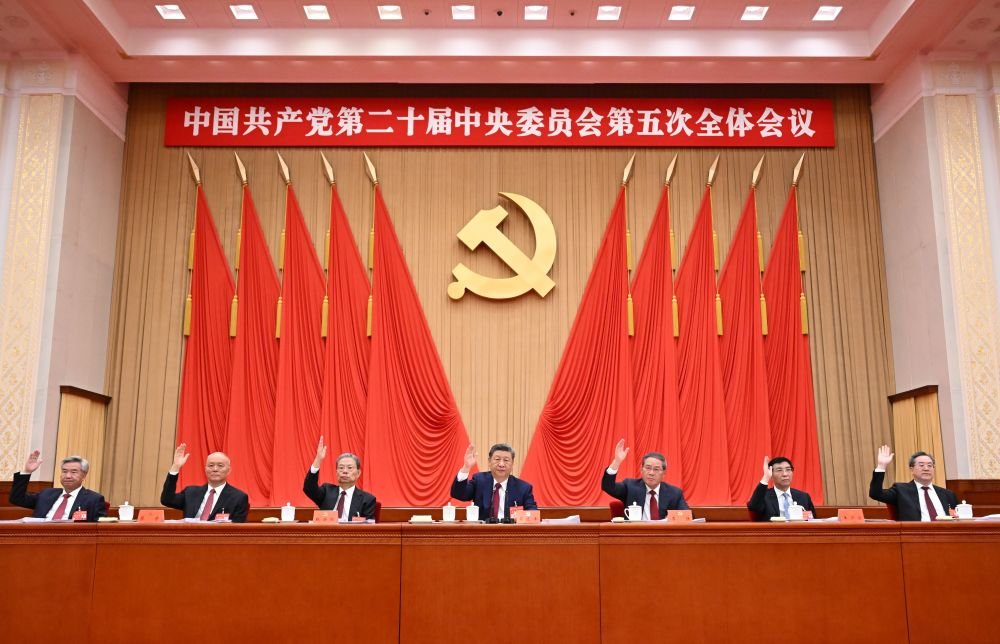
Takeaways from the Fifth Plenum
Key Takeaways
- The Fifth Plenum confirmed the expulsion of 33 civilian and military officials from the Party. Twenty more officials were absent without official explanation. Ten alternates were elevated to full Central Committee membership and CMC Vice Chairman Zhang Shengmin was elected to the Politburo.
- The Resolution adopted at the Fifth Plenum targets the cadre incentive structure through longer tenures and extends accountability for major decisions beyond an official’s transfer or retirement.
- New decision-making rules limit the unilateral authority of jurisdiction heads (一把手) and strengthen oversight of major decisions.
- The Resolution deepens coordination between the Central Organization Department (COD) and the Central Commission for Discipline Inspection (CCDI) on the appointment of leadership cadres, making discipline inspection review and joint sign-off by Party and discipline inspection organs preconditions for promotion.
Background
The 20th Central Committee of the CCP held its Fifth Plenum from October 26 to 29, 2026. Against the backdrop of a series of corruption investigations into both civilian and military officials, the overarching theme of the Fifth Plenum was strengthening Party self-governance. A major outcome of the Fifth Plenum was the Central Committee’s adoption of the Resolution of the Central Committee of the Communist Party of China on Certain Major Issues concerning Persevering with Full and Rigorous Party Self-Governance (《中共中央关于持之以恒推进全面从严治党若干重大问题的决定》; hereafter “the Resolution”). The Fifth Plenum was a highly anticipated event for China watchers looking for confirmation of personnel changes and potential preparations for the 21st Party Congress in 2027. The following sections summarize personnel changes and notable updates to the working structure of the CCP, including changes proposed in the Resolution to address the “correct view of political achievements,” Party decision-making, and an increased role of the Central Commission for Discipline Inspection (CCDI) in cadre appointments.
Personnel Changes
Central Committee membership is not always a reliable indicator of political backing or future advancement. The body’s composition prioritizes diverse representation of Party constituencies, which lends legitimacy to the General Secretary’s decisions.
Attendance at Party plenums has been used as an indicator of the political well-being of Central Committee members. Absence from the closing session usually signals an ongoing investigation and forthcoming expulsion from the Party. This year, a total of 162 members and 117 alternate members of the Central Committee attended the Fifth Plenum.1 The grids below show the officials promoted from alternate to full members of the Central Committee, as well as the civilian and military officials who were absent during the closing ceremony. Zhang Shengmin, the vice chairman of the Central Military Commission (CMC) and a deputy secretary of the CCDI, was also elevated to the Politburo.
It is important to understand that while the Central Committee formally elects the General Secretary of the CCP and members of its Politburo, membership is not always a reliable indicator of political backing or future advancement. The most obvious case that illustrates this point is the appointment of Li Shulei, current Politburo member and head of the Central Publicity Department, as a full member of the 20th Central Committee and the 20th Politburo simultaneously without prior membership in the 19th Central Committee. Notable omissions also include Jiang Jinquan and Tang Fangyu, the former and current heads of the Central Policy Research Office, a key Party organ that drafts the General Secretary’s speeches and written texts. Neither has ever been a member of the Central Committee. The Central Committee membership composition prioritizes diverse representation of Party constituencies, which lends legitimacy to the General Secretary’s decisions. A trend of declining attendance shows that membership in the Central Committee is neither a prerequisite for future advancement nor a guarantee of political security.
Updates on the correct view of political achievements
The General Office of the CCP Central Committee announced earlier this year an educational campaign on “Carrying Out Education on Establishing and Practicing a Correct View of Political Achievements Throughout the Party.” This exercise was largely to signal the shift away from GDP as a promotional metric. In our analysis, short tenure and high turnover of local officials were major contributors to perverse incentives. To address this issue, part IV, section 2 of the Resolution states that “[the Party] will refine the system of recusal and the practice of regular rotations and exchanges regarding official positions. [The Party] will improve and implement the tenure system for leading officials, and strictly implement the policies for maintaining stability over a term of office to prevent both frequent turnover in a post and frequent transfers of a single official.”2 With this messaging, the central leadership appears willing to accept a greater risk of factionalism in exchange for longer-term incentives.
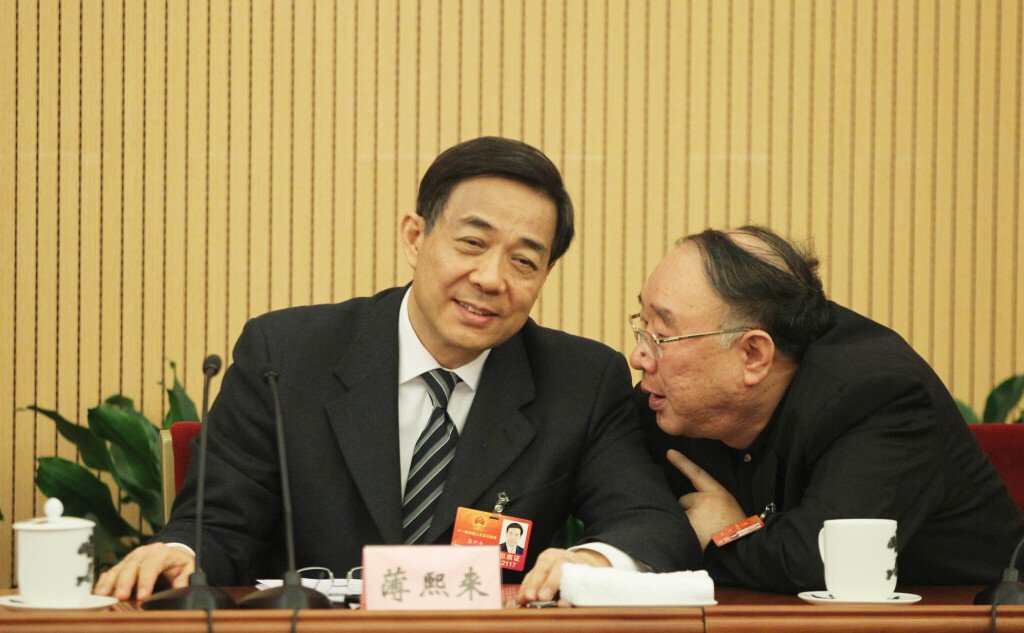
Bo Xilai (left), former Party Secretary of Chongqing, with Huang Qifan (right), former Mayor of Chongqing.
In August 2026 the General Office of the CCP Central Committee and the State Council issued a guideline establishing a lifelong accountability system for officials with regard to ecological and environmental damage.3 Part III, section 3 of the Resolution expands on this policy by stating that “[the Party] will also improve the lifelong accountability system for major decisions made by leading officials.”4 The Resolution emphasizes this point in part IV, section 6, adding that “management and oversight of retired officials will also be tightened.”5 This principle is illustrated by the recent downfall of Huang Qifan. The former Chongqing mayor, who left office nearly a decade ago and who many thought had survived the political purge of Bo Xilai, was placed under investigation two weeks before the plenum.6 The messaging to leadership cadres is clear: do not expect problems to disappear with a change of position or retirement.
Democratic centralism and decision-making reforms
The Party’s decision-making reforms pursue two primary objectives: constraining the top leader’s unilateral authority and strengthening both horizontal and vertical supervision at the local level.
Democratic centralism (民主集中制) is a core Marxist-Leninist organizational principle that combines open debate with unified execution. The State Council Information Office describes it as “both the Party’s fundamental organizational principle and the application of the mass line in everyday Party activities.”7 In practice, this translates to a decision-making process by which deliberation takes place within leadership groups at each level, but decision-making authority lies with the top leader (一把手) of each jurisdiction. Decision-making at all levels has long followed the popular saying “big meetings for small things, and small meetings for big things (小事开大会,大事开小会).” The more important the decision, the fewer people are involved in the final decision. In an interview, Yu Youjun, the former governor of Shanxi, recalled the difficulty of closing illegal coal mines in the province despite being its second-ranking official.8 Yu added that the Party has historically placed much greater value on experience as a jurisdiction’s top leader for future political advancement.
The Resolution announced at the Fifth Plenum makes several key statements regarding the decision-making process. The Resolution first confirms the current decision-making process in part III, section 3, stating that “decisions on all major issues must be made through group discussion in accordance with the principles of collective leadership, democratic centralism, pre-meeting contemplation, and meeting-based decision-making.”9 The Resolution then proposes four procedural constraints: (1) prior investigation, rationality evaluation, and risk assessment for major decisions, with no decision forced when major differences arise; (2) clearer limits on the heads’ powers, with the head speaking last;10 (3) restrictions on special meetings of Party committee secretaries substituting for standing committee meetings; and (4) reporting by heads on their supervision of lower-level heads.11
Taken together, the Party’s decision-making reforms pursue two primary objectives: constraining the top leader’s unilateral authority and strengthening both horizontal and vertical supervision at the local level. Shared accountability widens the circle of officials implicated by a poor decision, giving each leadership team a vested interest in protecting its collective choices while also making it more risk-averse. However, the Party anticipates this risk by prohibiting “collective rule breaking or responsibility shirking in the name of collective decision-making by Party committees.”12
Increased collaboration between COD and CCDI
At the Central Committee press conference held the day after the Fifth Plenum, seated at the center were Zhang Fuhai and Huang Jianfa, a deputy secretary of the CCDI and the executive deputy head of the Central Organization Department (COD). Zhang summarized the plenum’s four areas of focus for the Party’s ongoing anti-corruption campaign as “maintaining a tough stance against corruption, strengthening checks on and oversight over the exercise of power, fortifying the cultural-ethical foundations for championing integrity and disdaining corruption, and enhancing coordinated efforts to prevent corruption by rooting out audacity, opportunity, and desire.”13 Huang highlighted the Resolution’s emphasis on Party building in emerging sectors to increase the Party’s oversight over new types of economic and social organizations.14
Part IV, section 2 of the Resolution outlines the Party’s “targeted, well-designed measures to select and appoint officials.” Crucially, the document states that “before their promotion, candidates’ personal files are reviewed, their reports on personal information verified, opinions on them from discipline inspection and supervision organs solicited, and any specific, traceable reports as to their possible violations of Party regulations and discipline investigated.”15 This is an important point that suggests enhanced cooperation between the COD and CCDI in the appointment of centrally-managed cadres. Whereas the convention has been that the COD and CCDI have handled appointments and discipline inspection as separate functions, the Party has decided to further elevate the role of discipline inspection in cadre appointments by “requiring both Party committee secretaries and discipline inspection commission secretaries (including discipline inspection and supervision group leaders stationed in central Party organs and ministries) to sign the appraisal regarding the candidates’ integrity in work.”16 In an ideal scenario, preemptive discipline inspection vetting of officials is designed to weed out corrupt cadres before promotion. In a metric-driven bureaucracy where case numbers might serve as a performance measure and purges are often politically motivated, however, it is unlikely to reduce the number of corruption cases.
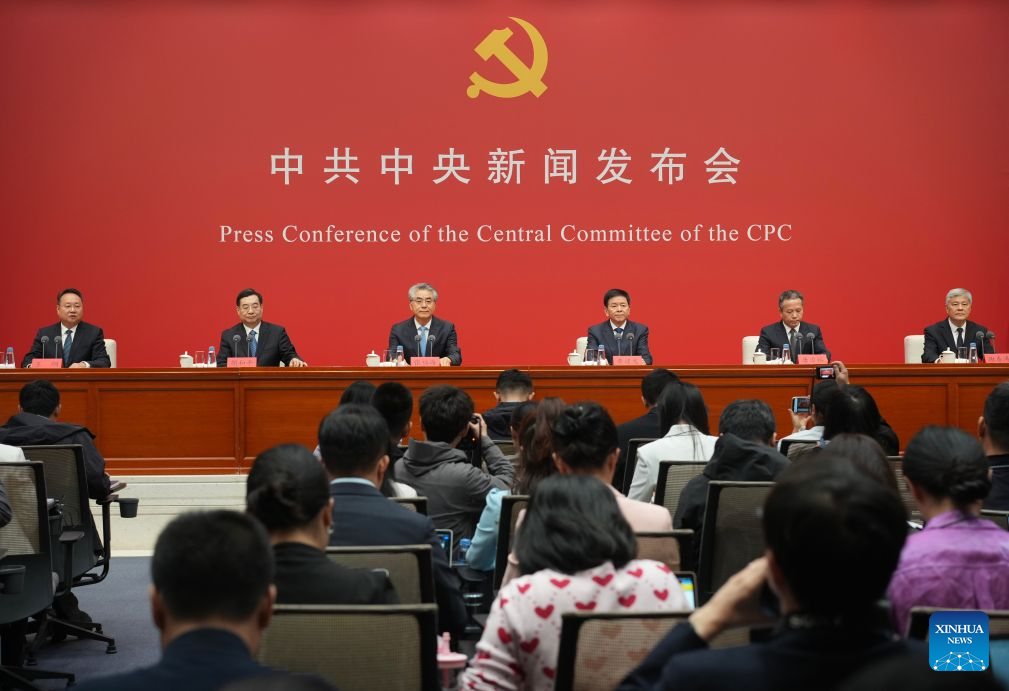
Press conference with Wang Gang, Hu Heping, Zhang Fuhai, Huang Jianfa, Tang Fangyu, and Xie Chuntao. Photo: Xinhua.
The Fifth Plenum of the 20th Central Committee was about more than the expulsion of civilian and military officials. It set forth a series of proposed changes to decision-making procedures, stronger supervision of local cadres, and lifelong accountability for leadership cadres. Crucial to the implementation of these changes is the increased role of the COD and CCDI in managing cadre assessments and vetting candidates for promotion. Whether constraints on the authority of top leaders will produce genuinely collective decision-making remains to be seen.
Notes:
- Central Committee of the Communist Party of China, “Communique of the Fifth Plenary Session of the 20th Central Committee of the Communist Party of China,” adopted October 29, 2026, Ministry of Foreign Affairs of the People’s Republic of China, October 29, 2026, https://www.fmprc.gov.cn/mfa_eng/xw/zyxw/202610/t20261029_12049543.html. ↩︎
- Central Committee of the Communist Party of China, Resolution of the Central Committee of the Communist Party of China on Certain Major Issues concerning Persevering with Full and Rigorous Party Self-Governance, adopted at the Fifth Plenary Session of the 20th Central Committee, October 29, 2026, English translation published by Xinhua, November 1, 2026, pt. IV, sec. 2, https://english.news.cn/20261101/16d34cfc97f04b8d925baf68d2963706/c.html. ↩︎ ↩︎
- Hou Liqiang, “Officials to Face Lifelong Ecological Accountability,” China Daily, August 26, 2026, https://www.chinadaily.com.cn/a/202608/26/WS6a8e4366e4b06d4aa055a7cc.html. ↩︎
- Central Committee of the CPC, Resolution on Persevering with Full and Rigorous Party Self-Governance, pt. III, sec. 3. ↩︎
- Central Committee of the CPC, Resolution on Persevering with Full and Rigorous Party Self-Governance, pt. IV, sec. 6. ↩︎
- “Former Right-Hand Man of Purged Chongqing Chief Bo Xilai under Investigation, China’s Graft Watchdog Says,” Reuters, October 13, 2026, https://www.reuters.com/world/asia-pacific/former-right-hand-man-purged-chongqing-chief-bo-xilai-under-investigation-chinas-2026-10-13/. ↩︎
- Academy of Contemporary China and World Studies, “Democratic Centralism,” China Keywords, State Council Information Office of the People’s Republic of China, updated December 10, 2024, http://english.scio.gov.cn/m/featured/chinakeywords/2024-12/10/content_117925530.htm. ↩︎
- CANNEWS, “独家:原广东省委宣传部长,山西省长于幼军官场记忆:那时候多少还能做点事情” [Exclusive: Former Guangdong Propaganda Chief and Shanxi Governor Yu Youjun’s Recollections of Officialdom: “Back Then, One Could Still Get Some Things Done”], YouTube video, 46:59, March 2, 2026, https://www.youtube.com/watch?v=c7pzgKTZr9E; Shi Jiangtao, “Governor ‘Cleans Up’ the Coal Industry,” South China Morning Post, March 16, 2007, https://www.scmp.com/article/585225/governor-cleans-coal-industry. ↩︎
- Central Committee of the CPC, Resolution on Persevering with Full and Rigorous Party Self-Governance, pt. III, sec. 3. ↩︎
- Central Committee of the CPC, Resolution on Persevering with Full and Rigorous Party Self-Governance, pt. III, sec. 4. ↩︎
- Central Committee of the CPC, Resolution on Persevering with Full and Rigorous Party Self-Governance, pt. III, sec. 4. ↩︎
- Central Committee of the CPC, Resolution on Persevering with Full and Rigorous Party Self-Governance, pt. III, sec. 3. ↩︎
- Xinhua, “CPC Outlines Four Areas of Focus in Anti-Corruption Drive,” Xinhua, October 30, 2026, https://english.news.cn/20261030/ad19b7c2d3ac435091be4d996dcbb469/c.html. ↩︎
- Xinhua, “CPC to Promote Party Building in Emerging Sectors: Official,” Xinhua, October 30, 2026, https://english.news.cn/20261030/65954d43cb93467db41f556aefb1f640/c.html. ↩︎
- Central Committee of the CPC, Resolution on Persevering with Full and Rigorous Party Self-Governance, pt. IV, sec. 2. ↩︎
- Central Committee of the CPC, Resolution on Persevering with Full and Rigorous Party Self-Governance, pt. IV, sec. 2. ↩︎
Thinking smarter about China
Subscribe to receive notifications on new articles.
If you would like to support us, please consider buying us a coffee.